
Quick answer
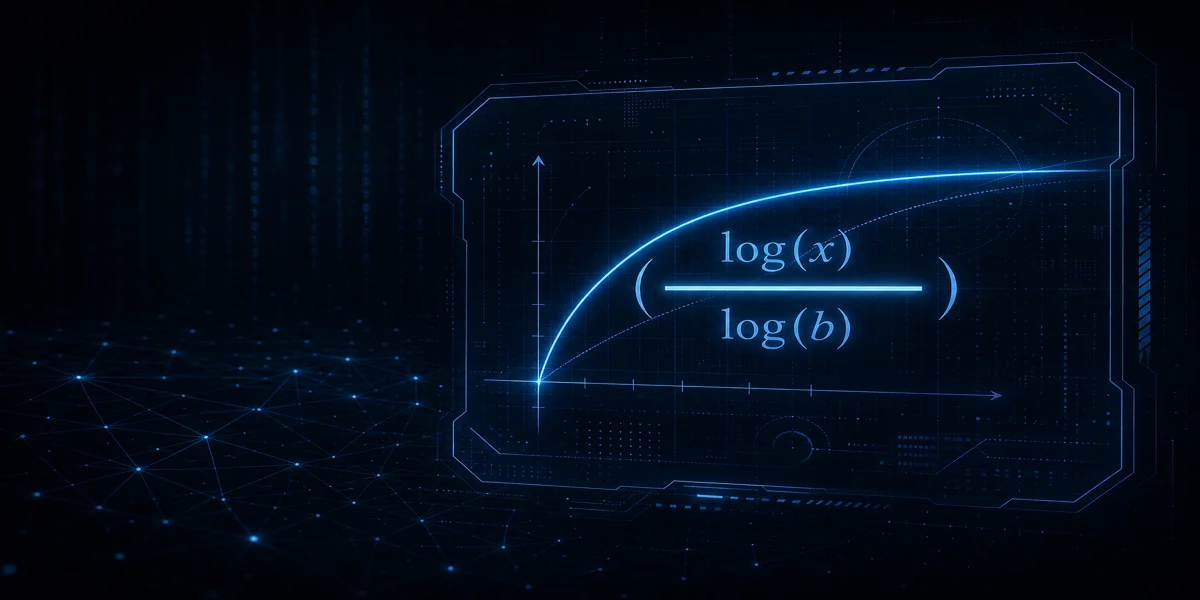
logb(x) = ln(x) / ln(b)
Formula
- ln is log base e
- e ≈ 2.71828
- Valid domain on x and b
Introduction
When formulas print ln, they are already using base e as the measuring stick. Change of base lets you translate that output into log10, log2, or any other valid base.
Natural log form is not a different identity; it is the general formula with a = e.
If your course contrasts ln with the log key, read the change of base vs common logarithm next; for all symbolic forms side by side, keep the full change of base formula reference open while you practice.
Check numbers in calculator in the home page hero after hand work.
Using ln(x) in conversions
ln(x) means loge(x). Treat e as the auxiliary base in the general ratio.
Scientific computations in physics and engineering often integrate or differentiate in base e, then report decimals in base 10.
Formula applications: growth and decay models, continuous compounding, and entropy-style expressions frequently use ln.
Engineering examples: sensor curves linearized with ln, then converted for dashboards that expect common logs.
Calculator work: use the ln key for both numerator and denominator when applying logb(x) = ln(x)/ln(b).
Do not mix ln in the numerator and log in the denominator unless you intentionally use a stated mixed-base line.
Natural log form
- log_b(x) = ln(x) / ln(b)
- ln(x) = log_e(x)
Set a = e in logb(x) = loga(x)/loga(b) to derive this line in one step.
Base-10 and general lines are the same identity with a = 10 or with a left symbolic.
Natural log form
- Identify target base b. Read what notation the final answer requires.
- Compute ln(x) and ln(b). Use calculator ln, not the log key, for this form.
- Divide and interpret units. Attach context from the word problem after the number is found.
- Compare with common log reports. State which auxiliary base you used so graders see you did not mix log and ln keys.
Science-style samples
Express log10(50) via ln: ln(50)/ln(10). Useful in spreadsheets with only LN().
If ln(100) ≈ 4.605, converting to log2(100) uses the same ln ratio with ln(2) in the denominator.
When reporting to a non-technical audience, name whether you used the log key or ln before you state a decimal.
Keep one auxiliary base in the ratio line so listeners are not left guessing which key you pressed.
Share this page